






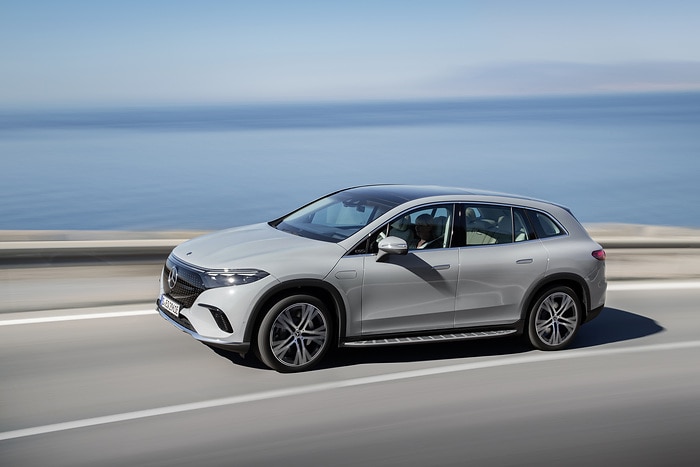
With a range of up to 660 kilometres (according to WLTP)[1] and an output of up to 400 kW, the EQS SUV also meets the requirements of a luxury SUV in terms of power delivery. All EQS SUVs have an electric drive train (eATS) on the rear axle, and the versions with 4MATIC also have an eATS on the front axle. In the 4MATIC models, the Torque Shift function ensures intelligent, continuously variable distribution of drive torque between the rear and front electric motors.
The modular drive concept allows a wide range of maximum total outputs from 265 to 400 kW. Depending on the vehicle equipment and configuration, WLTP ranges of up to 660 kilometres1 are possible.
The electric motors on the front and rear axles are permanently excited synchronous motors (PSM). On a PSM, the rotor of the AC motor is fitted with permanent magnets and therefore does not need to be supplied with power. The magnets – and thus the rotor – follow the rotating alternating current field in the stator windings. In the EQS SUV, Mercedes-Benz uses a so-called pull-in winding for a particularly strong magnetic field. The motor is referred to as synchronous because the rotor turns at the same rate as the magnetic field of the stator. The frequency is adjusted in the power electronics inverters to the speed requirements of the driver. The advantages of this design include high power density, high efficiency and high power constancy. The motor on the rear axle is particularly powerful due to its six-phase design: it has two windings with three phases each.
Cooling: sophisticated thermal concept for high load capacity
Consistently high performance and multiple accelerations without a drop in power characterise the drive philosophy of the EQS SUV. This includes a sophisticated thermal concept with some special features. A so‑called rotor cooling system in the shaft of the rotor cools it from the inside. Other cooling elements in the cooling circuit are fins on the stator, a needle-shaped pin-fin structure on the inverter and a transmission oil heat exchanger. This additionally brings more efficiency during cold driving, as it contributes to the heating of the transmission oil at the start of the drive and thus reduces friction in the transmission.
Intelligent energy recovery: one-pedal driving to a standstill
The EQS SUV offers several variants of energy recovery by means of regeneration. The driver can manually select the deceleration in three levels D+ (sailing), D (standard regeneration), D- (enhanced regeneration) via paddle shifters behind the steering wheel.
On top of this there is DAuto: In regeneration level DAuto, the ECO Assistant offers situation-adapted regeneration – it operates in gliding mode or decelerates in such a way that the bottom line is the most efficient and comfortable driving style possible. The driver is shown in the instrument cluster and, if applicable, on the head-up display when it is advisable to take the foot off the accelerator pedal due to an upcoming event. If the indication is followed, the vehicle is decelerated with the greatest possible energy recovery rate until it comes to a standstill if there is another vehicle ahead, for example. The driver does not need to operate the brake pedal for this – literally one-pedal driving. Up to 5 m/s² deceleration can be achieved, 3 m/s² of which by means of energy recovery.
4MATIC models: continuously variable distribution of the drive torques
The Torque Shift function ensures a continuously variable torque distribution between the two electric motors of the 4MATIC variants as needed and with optimised efficiency. Depending on the requirements, the torque distribution is regulated:
- Energy efficiency: When driving at a constant speed, an optimisation process determines the most efficient all-wheel-drive distribution in each case. The calculation takes into account that a permanent magnet synchronous machine can be switched off completely under certain conditions, which reduces the base load.
- Energy recovery power: Deceleration with the greatest possible energy recovery rate without overtaxing the grip of the wheels and thus endangering driving stability requires an adapted torque distribution. The energy recovery power of the versions with all-wheel drive is up to 290 kW[2]. A high energy recovery rate increases the range.
- Traction/acceleration: Here, the operating strategy distributes the drive torques just as ideally between the two axles. When cornering sportily, the operating strategy enables stable and neutral handling.
- Snow and ice: For maximum traction and driving stability also on snow and ice, the operating strategy detects spinning wheels and adjusts the torque distribution accordingly. Since both motors are controlled independently of each other, torque can still be provided to the other axle even if traction is lost on one axle.
- Off-road: In the OFFROAD driving mode, the all-wheel-drive distribution is optimised for unpaved roads, inclines and terrain.
Extensive testing: special test benches at Mercedes-Benz
On its way to series production, the EQS SUV covered many test kilometres, including at the Test and Technology Centre (PTZ) in Immendingen. The systematic validation of the overall vehicle serves to guarantee the high quality standards and is one of the extensive measures in the development process of every Mercedes-Benz model series. Stops included tough winter tests in Scandinavia, chassis and powertrain tests on proving grounds, public roads and on the high-speed test track in Nardò, as well as integrated overall vehicle heat testing in Southern Europe and South Africa. The EQS SUV was also on test drives in China, Japan, Dubai and the USA.
In the process, it completed the same demanding testing program as any other vehicle that can proudly wear a star. In addition, a number of tests were carried out specifically for electric cars, covering important development priorities such as range, charging and efficiency. Of course, special attention was paid to the e‑drive and the battery.
In addition, there were several million test kilometres on a total of more than two dozen test benches in Stuttgart-Untertürkheim and at the development site in Nabern. Testing takes place on pure eATS test benches, where the current comes from a special DC source, a so-called battery simulation, and on eDrive system test benches: Here, the testing also includes the battery and the complete charging components of the vehicle. The route profile/test bench profile was modified compared to the combustion engines, for example, to take into account the torque load on the transmissions in both directions – a special load case determined by the high energy recovery power. In addition, there is the special hot/cold testing of the power electronics.
[1] 536-660 km are the provisional range figures of the EQS 450+ (WLTP: combined power consumption: 23.0‑18.6 kWh/100 km; combined CO2 emissions: 0 g/km). Data on power consumption and range are provisional and were voluntarily determined internally in accordance with the “WLTP test procedure” certification method. There are no confirmed figures from an officially recognised testing organisation to date. Deviations from the final data are possible.
[2] This value refers to the electrical power fed into the electric battery due to recuperation. Deviations are possible