






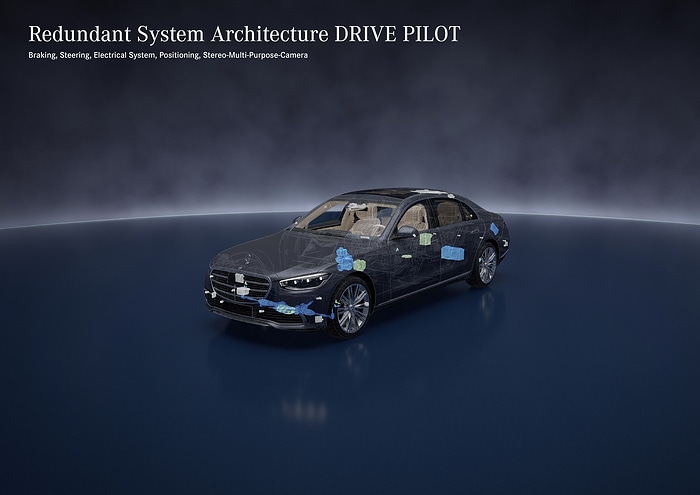
DRIVE PILOT: the world’s first internationally certified Level3 system
When it comes to conditionally automated driving (SAE Level 3), safety and reliability are the top priorities for Mercedes-Benz. DRIVE PILOT is therefore based on a system architecture that enables safe control of all situations that could potentially arise. To this end, braking, steering, power supply and some parts of the sensor system are designed with physical and functional redundancy. By adopting this safety‑focused approach to system design, Mercedes-Benz is setting completely new benchmarks in automated driving. DRIVE PILOT, the world’s first internationally certified system, has been available as an option for the S-Class and EQS in Germany since 17 May 2022.
The four core elements of the redundant architecture encompass the braking system, steering, power supply and some of the sensors. This includes environment recognition and handling. The battery, steering motor, wheel speed sensors and algorithms used by the system for data calculation are likewise duplicated. Some aspects of the sensor system are also functionally redundant because their different physical concepts (incl. optical; ultrasound; radio waves) are mutually corroborative, thus ensuring safe operation at all times. This mainly encompasses radar, cameras and a LiDAR. However, ultrasound and moisture sensors as well as microphones also deliver valuable data. Overall, more than 30 sensors ensure that DRIVE PILOT is reliably able to master the task of driving.
“The name Mercedes-Benz has always stood for safety. And we are already setting standards in the development and implementation of automated driving systems like DRIVE PILOT. We are convinced that redundancy is the right approach for Level 3 automated driving and beyond. When it comes to sensors, we also see the use of LiDAR alongside radar and cameras as particularly indispensable. We can compensate for the situation-dependent deficits of one sensor with the characteristics of another. Relying on just one type of sensor would not meet Mercedes-Benz’s high safety standards,” says Markus Schäfer, Member of the Board of Management of Mercedes-Benz Group AG, Chief Technology Officer, responsible for Development and Procurement.
Following activation of DRIVE PILOT, the system controls speed and distance, and keeps the vehicle in its own lane. Under certain conditions and on suitable sections of German autobahn, customers can hand over the task of driving to the system when traveling in heavy traffic or traffic jams at speeds of up to 60 km/h. In the unlikely event of a failure in one of the primary systems, the DRIVE PILOT system architecture is able to recognise the situation and facilitate a safe handover of control to the driver. Even if the driver is unable to comply with a handover prompt, e.g. due to a medical emergency, DRIVE PILOT initiates a safe emergency stop manoeuvre that does not pose a risk to traffic following behind.
Mercedes-Benz at the forefront of automated driving and safety technologies
Since the invention of the automobile in 1886, Mercedes-Benz has repeatedly set benchmarks in vehicle safety with innovative technologies. Safety is one of the brand’s core values, which is why Mercedes-Benz has been offering advanced driver assistance systems (SAE Level 2) in its vehicles for years. They can improve road safety and make life significantly easier in everyday situations. For instance, they provide assistance with speed and distance control, steering and switching lanes. In December 2021, Mercedes-Benz became the first automaker worldwide to receive internationally valid system approval for conditionally automated driving (SAE Level 3). In Germany, DRIVE PILOT has been available for the S-Class and EQS since 17 May 2021. And for parking, the brand has gone one step further – with pre-installation of INTELLIGENT PARK PILOT for the future facilitation of fully automated driverless parking to SAE Level 4.